Monday, January 6, 2020

Three Views of New Zealand: June-July 2010

     Though famous for its goofy footer's dreams, notably the endless left points of Raglan and Shipwreck Bay on the Tasman Sea, or the river-mouth sandbar at Whangamata on the Pacific side, New Zealand offers some classic set ups for the regular foot, and one need not go anywhere near Stent Rd. to find them.  (Sidebar note:  if you have serious aspirations toward Stent Rd., or the other nearby Taranaki reefs during the April-October swell season, consider up-gunning your quiver, and prepare yourself for some heavy-water workouts.)  With a set of wheels and a bit of time, the intrepid surf traveler can scour the map, find a promising section of coast, and enjoy some fabulously uncrowded perfection.
   
  Righthander #1
Somewhere south of Gisborne, June 2010.  Photo: S. Jacques Stratton

   If time, budget, or social schedule constrained exploration to one region of this long emerald country, I would choose the stretch of coast centered on Gisborne.  The region boasts a marvelous diversity of  quality breaks, from points to reefs to beach-break sandbars, and a contorted coast that transforms one spot's onshore crumblers into offshore peaks at another.  I won't state exactly where this wave is--no doubt surf-minded residents of the area will appreciate my sense of discretion--other than to mention that adjacent spots have graced the cover of Surfer's Journal and the nearby environs have a reputation for localism.
     On this particular day, late season cyclone swell from the north mingled with wrap-around energy from an Antarctic low, a fortunate combo, as the break acted like it preferred an energetic ocean and might get better with size.  The bigger waves formed juicy peaks with long walls, great for that style of top-to-bottom surfing characterized by carving turns and off-the-lips.  The smaller waves provided ideal platforms for roundhouse cutbacks; a surfer might string three or four in sequence before the maneuver turned monotonous.  I surfed an hour by myself, until two Kiwis, jealous of my solitude, determined I'd found the best reef for the conditions and paddled out to join me, followed a bit later by a smiling young longboarder from Japan.  For the next several hours we hooted each other in to set waves and traded surf stories, a motley crew unified by our appreciation of well-formed waves and the thrill of riding them.  Periodically I'd look back at the beach road, watching for the arrival of additional cars and the sight of surfers donning neoprene, sure that quality waves must inevitably draw crowds.  Yet no one else appeared, and the four of us surfed until hunger and cold turned our attention to matters other than swell, wind, and tide.

Righthander #2
Another roadside attraction, somewhere between Gisborne and Coromandel, June 2010.  Photo: S. Jacques Stratton  

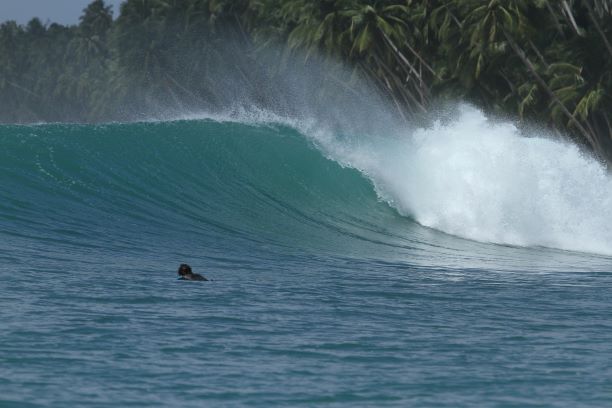
    Drive north from Gisborne toward Coromandel and you MIGHT encounter this phantom wave.  I call it a "phantom" to emphasize its whimsical temperament.  Highly dependent on swell direction and tide, the enticing peelers witnessed in a moment of sunshine might turn to grey closeouts in the time required to don a wetsuit and wax a board.  Despite this caveat, the beach had a photogenic appeal that made a visit worthwhile.  The water, glossed with turquoise hues resulting from the play of sunlight upon limestone sediments, resembled a swimming pool.  Breaking deep within a sheltered, isolated cove, the wave expressed a skittish personality, as if it needed an offering of food and a sniff of my hand as a prerequisite to more friendly relations.

 Wave #3

Coromandel corduroy, July 2010.  Photo:  S. Jacques Stratton

     To me, this shot offers a quintessential image of an east coast New Zealand beach scene:  caramel sand, picturesque offshore islets, corduroy lines of swell.  This spot sits next door to a well-known break that, in the manner of well-known breaks, owes its celebrity status to showy crowd-pleasing performances.  Meanwhile, surfers with a more refined sense of wave savvy, and the patience to wait for the proper tide, might hope for this little right-hander to turn on.
     I use the word "little" intentionally, because from what I could tell the break couldn't handle much more than about 8' on the face.  On this particular day, the swell, diminished from the intensity of the day before, delivered shoulder to head-high grinders along the outside sandbar section.
     The lineup proved shiftier up close than when viewed from the beach. I settled into position near a greybeard local whose robust wetsuit regalia, replete with gloves and hoodie, made me feel under-prepared.  The water isn't that cold, I thought to myself, trusting my senses.  I guess this guy just likes his neoprene.  With the deference of travelers to locals, I took a position that let him know he had priority for the next set.  The set arrived, and I waited for him to snag the choice wave.  Strangely, he remained passive, uninterested.  A feathering lip formed, yet my companion continued his stoic seaward stare.  Hating to let the wave go unridden, I quickly spun around, lunged forward with the lip, and raced a sandbar screamer that by most standards ranked high on the quality meter.  This scenario repeated itself about five more times, until I came to regard the stoic disinterest of the greybeard as a kind of silent rebuke of my enthusiasm. Finally, nonplussed by my companion's apathy to what I considered some dang good surf, I ventured conversation.
     "Some fun ones out here, eh?" I prodded, my voice modulated to my excitement.
     "If you say so, mate," came the deadpan reply.  His eyes, lit with an ethereal glow, seemed to illuminate the underside of his hoodie visor.
     "Well, I'm surprised how uncrowded it is.  I mean, we're the only guys out, and it's pretty much going off out here.  I just caught a smoking down-the-line section!"
     "Sometimes it's not about the surf," he explained, his voice slightly contemptuous.  "Sometimes it's better to just feel the motion of the water, breathe, and appreciate the waves for their beauty alone."   He fixed his eyes on me to see the impact of his words.  "Sometimes it's better just to paddle out and enjoy the scenery," he emphasized.
     An English teacher by trade, well versed in the tenets of critical thinking, I considered this idea with an open-minded tolerance.  Then I thought about the waves I rode, remembering the sweet resistance of water pushing against my inside rail as I dug into a bottom turn, and the weightless suspension of body and board as I smacked an off-the-lip.  Better to paddle out and enjoy the scenery?  Are you f-----g kidding me?  "Well, it's going off out here," I reiterated, as though the statement contained all the logic necessary to refute the greybeard's philosophy.
     Another set wave loomed, and I returned to the business of riding waves, while my companion returned to their contemplation. I had a strange sense that as much as I saw the folly in his ways, he saw the folly in mine.


Sunday, December 15, 2019

California Style vs. Aussie Antics (Sumatra 2014)

 Attempting to conform to the California Style Manual,.  Sumatra 2014. . .Photo: "Moppy."

This break was strictly fun-zone, a peeling wedge into a palm-lined bay, and unlike the nearby reefs, it concealed no critical sections where the difference between anguish and ecstasy depends on one's ability to dodge coral crags shallow enough to grind fins into powder. . . in other words, a break designed specifically for that brand of surfer whose predominant aesthetic perceives waves as  skateboard ramps.

The island that plays home to this break (and its more frequently photographed sibling further up the headland) has an imagistic legacy well represented in surf mags.  Yet while the tentacles of surf tourism have long groped toward it, the island retains the atmosphere of a frontier outpost, and still harbors a few secrets.

I well remember this particular session.  A handful of us--two Australians, a dilettante Swiss couple (skiers really, dabbling for a summer in the romance of surf travel) and myself--arrived via skiff from the beach camp.  A light overcast hung in the air, with enough density to spread a reflection of gray hues on the surface of the sea.  I watched the play of these hues in the wake that spun off the bow of the skiff.  The wake had a hypnotic effect, inducing in me the listless stupor that travelers to the tropics often experience.  Accordingly, the sight of a surf charter yacht anchored near the line up elicited, on my part, no more that a lackadaisical shrug.  I thought the tropical stupor which afflicted me would at some point descend on the charter yacht and similarly afflict its entourage of pampered surf rats.

As it turned out, the charter yacht posed little competition.  Its passengers, like a pack of lions sated from an earlier feast, watched our arrival with disinterest, and when they later ventured surfward, exhibited a preference for the aforementioned frequently-photographed break further up the headland.  Accordingly, the five of us from the beach camp had the skatepark arena of the inside wedge to ourselves.

The dilettante Swiss exhibited a lack of surf sense that meant they spent more time paddling than riding waves, but nevertheless exuded an enthusiasm that made me reflect fondly on my own days as a grommet, when the small details of the surfing experience--the fruity scent of fresh board wax, the silky feel of a glassy sea, the sudden acceleration of paddling into a wave--provided a delight to the senses.  The two Australians, happy for a respite from Perth's winter chill, surfed with a happy-go-lucky silliness that made me wonder if they too might be in the throes of a tropical stupor.  Arnie, riding a longboard, tried a fin-first takeoff on a prime set wave, and as the board spun into a 180-degree turn, casually attempted a switch-stance the opposite direction.  The move proved too ambitious, and as I watched Arnie succumb to an inevitable wipeout, I doubted the move's functionality.  Long a devotee of the California Style Manual, which dictates that making the wave counts for more than making the move, I directed some lighthearted criticism toward Arnie as he emerged from the froth:  "What are you?  A whirling dervish?"  In reply, Arnie flashed me a grin that told me he didn't give a damn about California surfing aesthetics and that his allegiance lay with a different dictum, one which posits that  the best approach to wave riding is the one that provides the most fun.  "Ah, no worries, mate! I reckon there's plenty more where that came from," he said.

In the end, it didn't really matter what particular surfing aesthetic we sought to uphold.  We all had fun, so much so that when afternoon brought the arrival of another charter yacht, we looked on with disinterest and returned to the skiff, like lions sated from feast.
"I reckon there's plenty more where that came from. . ."  Sumatra 2014.


Tuesday, December 10, 2019

Book Blurb: In Praise of THE VOLCANO TRILOGY by Quinn Haber

 
  In the manner of a dream, the prospect of living on a tropical island haunts the Western imagination.  To the cubicle-confined minions eager to trade corporate angst for balmy breezes, the idea evokes romantic escape.  We picture Paul Gauguin in Tahiti (or perhaps even Tom Hanks in Castaway) and think that with a little F-U money, we could ditch the cubicle for sunsets and mai tais.  Yet for most people, the dream of Expatica remains just that--a dream, something envisioned but never pursued.  For every hundred people that consider it, ten investigate, and of those ten, only one makes good the one-way ticket.

    The Volcano Trilogy, re-published by Phantasea Books in 2019 as an updated edition with additional photographs and postscript material, recounts how love for an island girl and steadfast commitment to a surf lifestyle enabled the author, Quinn Haber, to transform dream into reality.  Notably, Haber pursues his island dream while maintaining a full recognition of the downside to having a third-world address, as described in this excerpt from a chapter titled "A Fresh Coat of Paint:"

       Exotic, primeval, unsettling--no word can accurately describe the drive from the main highway to the beach.  In pasta-shaped convolutions, the badly deteriorating thoroughfare weaves through an impoverished village deeply ingrained in the surrounding hillside.  It's a hidden barrio of impossibly gnarled trees, houses made of scraps of anything, skinny people who seem to hide in their own shadows, and emaciated cattle standing in empty plots of dry dirt.  Here along the Philippines back roads, whole generations pass in utter poverty without the rest of the world ever seeing them or knowing they exist.  It's this very invisibility I find the most disturbing.  I know intellectually that ninety percent of the world's population make less that one U.S. dollar a day, and that poverty is relative by degrees of severity--after all, this is not widespread famine in the horn of Africa, and we do have a fair amount of poverty in the USA--but still, this shockingly visceral drive through the daily plight of the unknown Filipino is an experience I'll never forget.  There's absolutely no social welfare here, as far as I can see.
     To be aware of another's sufferings is to shade what might otherwise be a rosy backdrop in our lives.  Shall we simply cover the disturbing images with a fresh coat of paint, letting go of what we have seen, and move on?  Driving this road to Sabang reveals the hard struggle of developing nations, a reality most traveling surfers come into contact with at some point, or at many points, along their journeys.  As I watch the forlorn hinterlands disappear through the rear window, then turn to see a surfer's bounty of pristine beaches and waves, I feel humbled by the experience.

     Of course, confrontations with "otherness" comprise a key motif of travel literature, and few settings highlight otherness more than the poverty-stricken third world village.  For Haber, the confrontation evokes a sensitivity that establishes his credentials as a thoughtful commentator.  In the above passage, as throughout the book, Haber takes care to place descriptive detail within its social, historical, economic, and cultural context.

     As a surf travel memoir, the book places landscape and seascape front and center, but some scenes involve readers in Haber's mental landscape as well.  On occasion, the book recalls moments of personal challenge to which the author, in poetic fashion, attributes a metaphorical significance.  Haber's recollection of a cliff-dive, and the lesson it presents for his romantic aspirations, stands out as an example:

     Fraser takes me on a short but steep climb to the top of the promontory.  We walk out over the rocky cranium and look down at the water, some sixty feet below.
     "Jump" he says--or was that an order?
     "Really?  From here?"
     "Yeah mate.  I do it all the time."
     "It looks pretty far."
     "Only fifty feet or so , mate, depending on the tide."
     "Well, what's the tide now?"
     "I think it's coming up, mate."
     "How deep is it?"
     "Plenty deep, mate.  No worries.  No worries at all.  Just keep ye arms and legs together so they don't get torqued on impact, and cover ye pearls with ye hands."
     "My pearls?"
     "That's right, mate.  Ye jewels."
     "Are you going to jump?"
     "Nah, ya should jump mate!  I do it all the time.  It's really not as high as it looks."
     "I'll go if you go first."
     "That won't work, mate.  Who'll carry our shirts, hats, and sunglasses back?  Not to mention my wallet?"
     "You brought your wallet?"
    "Mate, in the Philippines, ya never know when ya'll need to prove yourself with some identification or a bribe.  So are ya going to jump or not, mate?  I haven't got all day."
     I look over the ledge and see a collage of blues delineating various patches of reef at differing water depths.
     "Are you sure I won't hit bottom?"
     "Ah, no dramas, mate!  It's at least eight meters deep."
     I hesitate, then slowly pull off my shirt and sunglasses and give them to the man that resembles Clint Eastwood now more than ever.  It's as if I'm handing the last of my personal belongings to my executioner.
     "Okay, Fraser," I mumble, "I guess I'm going."
     "Only if ya want to, mate.  I don't want to pressure ya."
     But by now, having removed my personal effects, I feel irrevocably committed.  I inch towards the ledge and peek over again.  There's nothing between me and the water but a great distance of air.  I begin to hesitate, but before I let my mind take over, I leap over the edge and feel the wind rushing up all around me.  I reach for my 'pearls' and soon am engulfed by the liquid blue.  I don't penetrate very deep and the whole thing is over quickly.  Fraser was right, it's an easy jump and drama isn't necessary.
     Going for things should be like this--once you decide to commit, you shouldn't hesitate and psyche yourself out, but just do it and jump!  I think that proposing to Janice, if that is ultimately what I decide, will require this same sort of leap.

    As revealed in the book's postscript material, the author did end up making the lifestyle leap, though it involved a path more circuitous and fraught with unexpected complications than anyone could have realized.  No spoilers here, other than this: the postscript material alone, with its overview of events that take place in years subsequent to those depicted in the narrative, makes the purchase price worthwhile.

     As a veteran of four trips to the Philippines, one completed as recently as 2019, I can attest to the accuracy of the book's back-cover synopsis, which touts Haber as a keen-eyed witness, whose "observations of the Philippines far north present a compelling view of Southeast Asian life, encompassing everything from local traditions, to courtship mores, to exquisite country surf and tourist sites."  The surf traveler, understandably interested in depictions of the "exquisite country surf," will find the following excerpt a representative sample of the play-by-play accounts:

     I pick up the binoculars and study the break again.  Star Tubes, a right-hander peeling off the  
It's a fast and hollow wave. . .Star Tubes, December 2001.  Photo: S. Jacques Stratton
tip of a reef shelf, is not known to handle too much size.  It's a fast and hollow wave, and quite shallow.  Today it is clearly off the Richter scale, with frequent, big sets thrusting over the shelf, their open faces reflecting the gleam of sunrise one second, then turning dark the next as they hollow out and detonate into the shallows.  After each bomb, the sound of the explosion resounds off the lodge walls seconds later, like an eerie aftershock evincing a mere afterthought of the wave's  true power.  Even from here, a half mile away, Star Tubes looks scary enough.  Moments later, I see Fraser walking out across the causeway, heading towards the bay with surfboard in hand.  I ponder what the hell to do. . .
 No pondering here.  Haber drops in to "Starries," December 2001.  Photo:  S Jacques Stratton

Accompanied by a cornucopia of photographs, such passages give the reader a front row seat to the action.

     As a "genre" the surf travel memoir remains obscure, a curiosity within the broader tradition of travel literature.  In part the obscurity stems from social attitudes, prevalent until recently, toward surf culture.  For decades dismissed by the mainstream as vagabonds unworthy of serious attention, surfers more frequently supplied stereotypes for film and T.V. (think Jeff Spiccoli from Fast Times at Ridgemont High) than interesting protagonists.  For its part, surf culture often encouraged its marginality, maintaining through slang and hatred of outsiders a tribal insularity enigmatic to the mainstream.  Knowing this dynamic, publishers regarded book-length surf travel narratives with skepticism, recognizing their extremely limited audience appeal.  In recent years this has begun to change.  Advertisements for products ranging from cars to beer now promote surfing as an desirable component in an adventure lifestyle, and the conflation of surfing with popular lifestyle fads (witness the profusion of Yoga/Surf retreats) brings surf culture into the mainstream.  In tandem with this trend, the surf travel memoir has begun to gain traction as a literary form, with prominent works such as Allan Weisbecker's In Search of Captain Zero setting the bar.  For its comprehensive exploration of a region still regarded as a surf frontier, Quinn Haber's Volcano Trilogy deserves honorable mention alongside such works, and I think fans of surf travel memoirs will find it a worthy addition to their bookshelves.