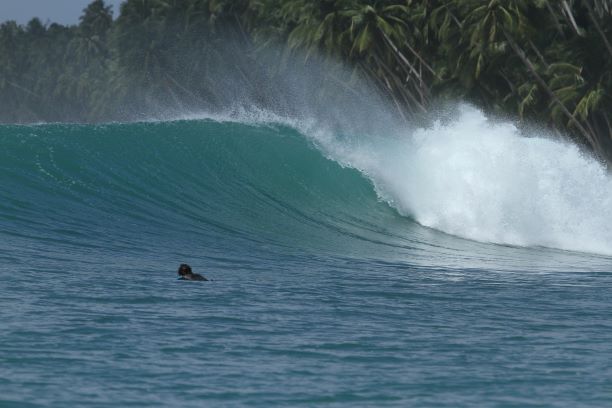
In the manner of a dream, the prospect of living on a tropical island haunts the Western imagination. To the cubicle-confined minions eager to trade corporate angst for balmy breezes, the idea evokes romantic escape. We picture Paul Gauguin in Tahiti (or perhaps even Tom Hanks in Castaway) and think that with a little F-U money, we could ditch the cubicle for sunsets and mai tais. Yet for most people, the dream of Expatica remains just that--a dream, something envisioned but never pursued. For every hundred people that consider it, ten investigate, and of those ten, only one makes good the one-way ticket.
The Volcano Trilogy, re-published by Phantasea Books in 2019 as an updated edition with additional photographs and postscript material, recounts how love for an island girl and steadfast commitment to a surf lifestyle enabled the author, Quinn Haber, to transform dream into reality. Notably, Haber pursues his island dream while maintaining a full recognition of the downside to having a third-world address, as described in this excerpt from a chapter titled "A Fresh Coat of Paint:"
Exotic, primeval, unsettling--no word can accurately describe the drive from the main highway to the beach. In pasta-shaped convolutions, the badly deteriorating thoroughfare weaves through an impoverished village deeply ingrained in the surrounding hillside. It's a hidden barrio of impossibly gnarled trees, houses made of scraps of anything, skinny people who seem to hide in their own shadows, and emaciated cattle standing in empty plots of dry dirt. Here along the Philippines back roads, whole generations pass in utter poverty without the rest of the world ever seeing them or knowing they exist. It's this very invisibility I find the most disturbing. I know intellectually that ninety percent of the world's population make less that one U.S. dollar a day, and that poverty is relative by degrees of severity--after all, this is not widespread famine in the horn of Africa, and we do have a fair amount of poverty in the USA--but still, this shockingly visceral drive through the daily plight of the unknown Filipino is an experience I'll never forget. There's absolutely no social welfare here, as far as I can see.
To be aware of another's sufferings is to shade what might otherwise be a rosy backdrop in our lives. Shall we simply cover the disturbing images with a fresh coat of paint, letting go of what we have seen, and move on? Driving this road to Sabang reveals the hard struggle of developing nations, a reality most traveling surfers come into contact with at some point, or at many points, along their journeys. As I watch the forlorn hinterlands disappear through the rear window, then turn to see a surfer's bounty of pristine beaches and waves, I feel humbled by the experience.
Of course, confrontations with "otherness" comprise a key motif of travel literature, and few settings highlight otherness more than the poverty-stricken third world village. For Haber, the confrontation evokes a sensitivity that establishes his credentials as a thoughtful commentator. In the above passage, as throughout the book, Haber takes care to place descriptive detail within its social, historical, economic, and cultural context.
As a surf travel memoir, the book places landscape and seascape front and center, but some scenes involve readers in Haber's mental landscape as well. On occasion, the book recalls moments of personal challenge to which the author, in poetic fashion, attributes a metaphorical significance. Haber's recollection of a cliff-dive, and the lesson it presents for his romantic aspirations, stands out as an example:
Fraser takes me on a short but steep climb to the top of the promontory. We walk out over the rocky cranium and look down at the water, some sixty feet below.
"Jump" he says--or was that an order?
"Really? From here?"
"Yeah mate. I do it all the time."
"It looks pretty far."
"Only fifty feet or so , mate, depending on the tide."
"Well, what's the tide now?"
"I think it's coming up, mate."
"How deep is it?"
"Plenty deep, mate. No worries. No worries at all. Just keep ye arms and legs together so they don't get torqued on impact, and cover ye pearls with ye hands."
"My pearls?"
"That's right, mate. Ye jewels."
"Are you going to jump?"
"Nah, ya should jump mate! I do it all the time. It's really not as high as it looks."
"I'll go if you go first."
"That won't work, mate. Who'll carry our shirts, hats, and sunglasses back? Not to mention my wallet?"
"You brought your wallet?"
"Mate, in the Philippines, ya never know when ya'll need to prove yourself with some identification or a bribe. So are ya going to jump or not, mate? I haven't got all day."
I look over the ledge and see a collage of blues delineating various patches of reef at differing water depths.
"Are you sure I won't hit bottom?"
"Ah, no dramas, mate! It's at least eight meters deep."
I hesitate, then slowly pull off my shirt and sunglasses and give them to the man that resembles Clint Eastwood now more than ever. It's as if I'm handing the last of my personal belongings to my executioner.
"Okay, Fraser," I mumble, "I guess I'm going."
"Only if ya want to, mate. I don't want to pressure ya."
But by now, having removed my personal effects, I feel irrevocably committed. I inch towards the ledge and peek over again. There's nothing between me and the water but a great distance of air. I begin to hesitate, but before I let my mind take over, I leap over the edge and feel the wind rushing up all around me. I reach for my 'pearls' and soon am engulfed by the liquid blue. I don't penetrate very deep and the whole thing is over quickly. Fraser was right, it's an easy jump and drama isn't necessary.
Going for things should be like this--once you decide to commit, you shouldn't hesitate and psyche yourself out, but just do it and jump! I think that proposing to Janice, if that is ultimately what I decide, will require this same sort of leap.
As revealed in the book's postscript material, the author did end up making the lifestyle leap, though it involved a path more circuitous and fraught with unexpected complications than anyone could have realized. No spoilers here, other than this: the postscript material alone, with its overview of events that take place in years subsequent to those depicted in the narrative, makes the purchase price worthwhile.
As a veteran of four trips to the Philippines, one completed as recently as 2019, I can attest to the accuracy of the book's back-cover synopsis, which touts Haber as a keen-eyed witness, whose "observations of the Philippines far north present a compelling view of Southeast Asian life, encompassing everything from local traditions, to courtship mores, to exquisite country surf and tourist sites." The surf traveler, understandably interested in depictions of the "exquisite country surf," will find the following excerpt a representative sample of the play-by-play accounts:
I pick up the binoculars and study the break again. Star Tubes, a right-hander peeling off the
 |
| It's a fast and hollow wave. . .Star Tubes, December 2001. Photo: S. Jacques Stratton |
tip of a reef shelf, is not known to handle too much size. It's a fast and hollow wave, and quite shallow. Today it is clearly off the Richter scale, with frequent, big sets thrusting over the shelf, their open faces reflecting the gleam of sunrise one second, then turning dark the next as they hollow out and detonate into the shallows. After each bomb, the sound of the explosion resounds off the lodge walls seconds later, like an eerie aftershock evincing a mere afterthought of the wave's true power. Even from here, a half mile away, Star Tubes looks scary enough. Moments later, I see Fraser walking out across the causeway, heading towards the bay with surfboard in hand. I ponder what the hell to do. . .
 |
| No pondering here. Haber drops in to "Starries," December 2001. Photo: S Jacques Stratton |
Accompanied by a cornucopia of photographs, such passages give the reader a front row seat to the action.
As a "genre" the surf travel memoir remains obscure, a curiosity within the broader tradition of travel literature. In part the obscurity stems from social attitudes, prevalent until recently, toward surf culture. For decades dismissed by the mainstream as vagabonds unworthy of serious attention, surfers more frequently supplied stereotypes for film and T.V. (think Jeff Spiccoli from Fast Times at Ridgemont High) than interesting protagonists. For its part, surf culture often encouraged its marginality, maintaining through slang and hatred of outsiders a tribal insularity enigmatic to the mainstream. Knowing this dynamic, publishers regarded book-length surf travel narratives with skepticism, recognizing their extremely limited audience appeal. In recent years this has begun to change. Advertisements for products ranging from cars to beer now promote surfing as an desirable component in an adventure lifestyle, and the conflation of surfing with popular lifestyle fads (witness the profusion of Yoga/Surf retreats) brings surf culture into the mainstream. In tandem with this trend, the surf travel memoir has begun to gain traction as a literary form, with prominent works such as Allan Weisbecker's In Search of Captain Zero setting the bar. For its comprehensive exploration of a region still regarded as a surf frontier, Quinn Haber's Volcano Trilogy deserves honorable mention alongside such works, and I think fans of surf travel memoirs will find it a worthy addition to their bookshelves.